On today’s show we learn about the Canelillo, a critically endangered broadleaf evergreen rainforest tree native to the Pacific coast of Costa Rica in Central America. Its scientific name is Pleodendron costaricense and it was first described in 2005.
Rough Transcript
Intro 00:05
Welcome to Bad at Goodbyes.
On today’s show we consider the Canelillo.
Species Information 02:05
The Canelillo is a critically endangered broadleaf evergreen rainforest tree native to the Pacific coast of Costa Rica in Central America. Its scientific name is Pleodendron costaricense and it was first described in 2005. It has an ancient lineage, we have fossil evidence of Pleodendron pollen in Costa Rica from roughly 28 million years ago.
Description
Pleodendron costaricense, the Canelillo, is an enormous, tall, tropical, canopy tree that can reach heights between 50 and 115 feet, with trunk diameters exceeding 20 feet. They grow a single straight cylindrical main trunk, typically clear of branches until the upper bounds of their height. The crown is dense, rounded, or somewhat spreading once those upper branches reach the canopy.
Their outer bark is thin, gray and white with a scaly, cracked texture. Then the next layer just below, the inner bark, is a pale pink color and smells of sweet mint and cinnamon, from a concentration of oils stored throughout this tissue. Their heartwood and sapwood, the innermost layers of the trunk are dense, and white to pale yellow.
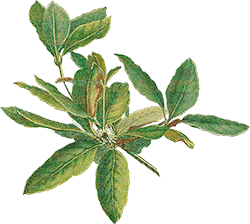
The Canelillo’s leaves are oblong, measuring 3 to 6 inches in length and 1 to 2 inches in width. The leaf surfaces are smooth and have entire margins, meaning smooth edges. The leaves have a spicy, peppery flavor.
Reproduction
The Canelillo flowers in February or March, producing small pale greenish-yellow blooms of twelve petals arranged in a series of three layers. The outer petals are thick and fleshy (succulent); the inner petals are thin and delicate (membranaceous), marked by light lines.
The flowers are bisexual, meaning that both male and female reproductive organs occur in the same bloom. The
Canelillo’s male reproductive pollen-producing parts, the stamen, are fused together in a staminal column, a tube that surrounds the upper part of the ovary, the female reproductive organ. At the top of the ovary, the pollen-receiving stigma is rounded and divided into six lobes.
Though unconfirmed by observational research, the Canelillo is likely pollinated by small beetles and flies. These small insects are pollen-feeders, attracted to the Canelillo’s spicy aroma. The insects feed, the flower’s succulent petals and fused stamen protect the ovary from being consumed, and when the insects move from flower to flower, pollen is spread.
Once fertilized, the flower produces a green, smooth berry about an 1 inch in diameter, containing many small, black, shiny seeds. The Canelillo fruits in July and August, and their seeds are spread by zoochory, by animals, in this case, mammals. Camera trap studies have observed that Kinkajou and Olingo (these are small tree-dwellers in the racoon family), White-nosed Coati (these are small ground dwellers, also in the raccoon family) and Central American Woolly Opossum, a marsupial, will consume the berries and disperse the seeds in their feces.
The Canelillo’s seeds are also distributed by White-faced Capuchin Monkeys. The monkeys do not eat the fruit, instead they engage in “social anointing”. The monkeys bite into the berry, releasing essential oils and then rub the pulp onto their fur and onto the fur of their companions. Scientists believe this is a kind of communal medicinal behavior. The fruit’s oils are a topical fungicide that the monkeys use to prevent skin infections caused by fungus. Additionally the oils are an insect repellent, deterring mosquitoes and biting flies. And the oils may also be a social olfactory cue, the scent application and scent itself serve as a kind of social bonding. We have camera trap evidence of this behavior and it appears the monkeys seek out the Canelillo specifically, like they do not do this with other fruit, suggesting that they have some understanding of the fruit oil’s medicinal properties and/or have a preference for its scent.
In The Dream
————
In the dream,
Collecting seeds, climbing a hundred feet, into the canopy
My hands, my skin upon the bark of this ancient tree
Listening for the soft echos of its long story,
Gathering green verses to planted anew,
In hopes its song continues.
In the dream.
————
Habitat
The Canelillo is native to Costa Rica, in Central America, near the Pacific Coast, specifically found in the southwest of the country, in the Parrita district and on the Osa Peninsula. This is a tropical lowland rainforest, and the Canelillo is found on the slopes of coastal hills, from roughly sea-level to 1000 feet in elevation. Much of this habitat is old-growth forest, having never been cleared: old tall thick trees and a dense understory of palms and giant ferns. The soil is generally a deep red, acidic clay and the forest floor is dense with leaf litter.
The climate is consistently tropical with year-round highs in the low 90s°F, and nighttime lows rarely dip below 70°F. Rainfall is wildly abundant. Precipitation averages roughly 190 inches per year. That is almost 16 feet of rain, over a foot of rain per month, resulting in a verdant rainforest of lush vegetation.
The Canelillo shares its rainforest home with:
White-nosed Coati, Diesel Tree, Central American Squirrel Monkey, Cedrón, Spiny Palm, Ocelot, Spiral Ginger, Silk Cotton Tree, White-faced Capuchin, Scarlet Macaw, Passionflower, Mantled Howler Monkey, Balsa, Rubber Tree, Root-Spine Palm, Central American Woolly Opossum, Eyelash Palm Pit Viper, Olingo, Kinkajou, Jaguar, Garlic Tree, Black-cheeked Ant-Tanager, Silky Anteater, Red-eyed Tree Frog, Baird’s Tapir, Puma, Walking Palm, Three-toed Sloth, and many many more.
Threats
The primary current threat to the Canelillo is simply low population. The tree is rare and some of its few remaining individuals are very spread out. So low population first results in a lack of genetic diversity, which reduces the species’ ability to adapt to new pests, new diseases, or changing climate conditions. And their low population density imperils natural regeneration. The Canelillo, like many plant species, dedicates significant resources to producing a very large quantity of reproductive material, relying on abundance and chance - hedging bets that given ample opportunity a beetle or a fly will in fact transfer pollen from one individual to another. But when there are less individuals and those individuals are spread out, the odds, the chance, the likelihood of successful fertilization, goes down. This is called pollen limitation.
Additionally human habitat degradation and destruction threatens the remaining Canelillo population. Across the 20th century, segments of the Canelillo’s habitat were clear-cut for agriculture: oil palm plantations, cattle ranching, and pineapple farming. Infrastructure, specifically new roads in the Parrita region, have also fragmented this habitat. And though there is no evidence of direct effect yet, camera trap studies accidentally captured evidence of illegal logging in the same forests where the Canelillo grow.
And lastly, human induced climate change, due to persistent over-reliance on fossil fuel burning, is an imminent threat. As global warming results in sea level rise, low-lying coastal and near coastal vegetation is at risk.
Conservation
Fortunately about a quarter of the Canelillo’s remaining population is on government protected land.
An off-site propagation program in 2021 was able to successfully germinate and grow roughly 150 seedlings, 59 of which were replanted in the tree’s natural habitat on the Osa Peninsula. A follow up study in 2022 observed that about 40 seedlings survived that first year.
Nevertheless the Canelillo has been considered critically endangered on the IUCN Red List since 2019 and their population is currently in decline.
Our most recent counts estimate that less than 15 Canelillo remain in the wild.
Citations 21:02
Information for today’s show about the Canelillo was compiled from:
Bezanson S, Curtis S, Mata-Quiros M, Mata-Quiros MJ, Durst T (2024) Phytochemistry of the Fruit of the Critically Endangered Tree Pleodendron Costaricense (Canellaceae). JSM Environmental Science and Ecology 12(1): 1091. – https://www.jscimedcentral.com/jounal-article-info/JSM-Environmental-Science-and-Ecology/Phytochemistry-of-the-Fruit-of-the-Critically-Endangered-Tree-Pleodendron-Costaricense-(Canellaceae)—11736#
Endress, P. K. (2010). The evolution of floral biology in basal angiosperms. Philosophical Transactions of the Royal Society B: Biological Sciences, 365(1539), 411–421. – https://doi.org/10.1098/rstb.2009.0228
Hammel, Barry E., and Nelson A. Zamora. 2005. “Pleodendron costaricense (Canellaceae), a New Species for Costa Rica.” Lankesteriana 5 (3): 211–218. – https://doi.org/10.15517/lank.v5i3.19758
Mata, M., and Calvo Guerrero, M. Preformulación teórica de un producto natural antifúngico a partir de extractos obtenidos de las hojas del árbol Pleodendron costaricense. Revista Ciencia Y Salud, 6(6). – https://doi.org/10.34192/cienciaysalud.v6i6.554
Müller, Sebastian, Karsten Salomo, Jackeline Salazar, Julia Naumann, M. Alejandra Jaramillo, Christoph Neinhuis, Taylor S. Feild, and Stefan Wanke. 2015. “Intercontinental Long-Distance Dispersal of Canellaceae from the New to the Old World Revealed by a Nuclear Single Copy Gene and Chloroplast Loci.” Molecular Phylogenetics and Evolution 84 (March): 205–19. – https://doi.org/10.1016/j.ympev.2014.12.010
Osa Arboretum. n.d. “Pleodendron costaricense.” – https://osa-arboretum.org/plant/pleodendron-costaricense/
Pillco Huarcaya R, López Morales M, Álvarez-Alcázar L, Whitworth A. The First Ex-Situ Germination and Dispersal Mechanisms of the Rare, Critically Endangered Tree, Pleodendron costaricense. Tropical Conservation Science. 15 (1). 2022.– https://doi.org/10.1177/19400829221104572
Rivers, M.C. 2019. Pleodendron costaricense. The IUCN Red List of Threatened Species 2019: e.T136055038A136055040. – https://dx.doi.org/10.2305/IUCN.UK.2019-3.RLTS.T136055038A136055040.en
Roque, Roger Moya; Salazar, Manuel Morales; Wiemann, Michael C.; Alvarez, Luis Poveda. 2007. Wood anatomy of Pleodendron costaricense (Canellaceae) from Southern Pacific, Costa Rica. Brenesia. Vol. 68 (2007): p. 25-28. - https://www.fpl.fs.usda.gov/documnts/pdf2007/fpl_2007_roque001.pdf
Smith, Paul. 2021. “The Need for Horticulturist Expertise in Plant Conservation: Challenges and Opportunities”. Sibbaldia: The International Journal of Botanic Garden Horticulture, no. 20 (June): 45-56. – https://doi.org/10.24823/Sibbaldia.2021.316
Zimmer, Elizabeth A., Y Suh, and Kenneth G Karol. 2012. “Phylogenetic Placement of a Recently Described Taxon of the Genus Pleodendron (Canellaceae).” Phytologia 94 (3): 404—412. – https://www.biodiversitylibrary.org/part/184468.
For more information about Canelillo conservation see Osa Conservation at https://osa-arboretum.org.
Music 22:57
Pledge 27:41
I honor the lifeforce of the Canelillo. I will commit its name to my record. I am grateful to have shared time on our planet with this being. I lament the ways in which I and my species have harmed and diminished this species. I grieve.
And so, in the name of the Canelillo I pledge to reduce my consumption. And my carbon footprint. And curb my wastefulness. I pledge to acknowledge and attempt to address the costs of my actions and inactions. And I pledge to resist the harm of plant and animal kin and their habitat, by individuals, corporations, and governments.
I forever pledge my song to the witness and memory of all life, to a broad celebration of biodiversity, and to the total liberation of all beings.